A long weekend in Colombo is usually shaped by half its residents heading out of the city. I am almost always one of them.
Most head to the hills, where cooler temperatures attract scorched urban residents in search of mist and dew, and a break from Colombo’s heat. Others head south. Peak season or low season, the south has always been a 365-day destination for locals. Beaches, good food and peak island life. Some go on pilgrimage. To Kataragama in the deep South, Jaffna with its kovils, Madhu Church in Mannar, or Kandy and Anuradhapura, ancient kingdoms where Buddhist heritage is still very much alive.
In many ways, these are also the versions of Sri Lanka we tend to show foreign travellers. The hills. The beaches. The ancient cities. The wildlife parks.
I, on the other hand, am drawn to the dry zone.
Scorching hot. Barely any rain during the dry season. Dotted with tanks, the seasonal ones can dry up to the point of being barely recognisable, while the perennial tanks shrink considerably as the months without rain drag on. This is elephant country. People and elephants have shared this landscape for generations, although changes in land use and the overlap between elephant range and agricultural land have made that relationship increasingly difficult in many parts of Sri Lanka. Among the vast dry zone, I have a few favourite escapes that I have come to revisit over the years. The area around Galkadawala is one of them.
Returning to Galkadawala
Galkadawala sits about 10 kilometres from Habarana and not far from Sigiriya, surrounded by paddy fields, tanks and patches of forest.
I stay in a forest lodge, on a small patch of reforested land near Galkadawala Tank. I have made it a habit to return at least once a year, mostly to disappear for a few days and spend some time away from online activity.
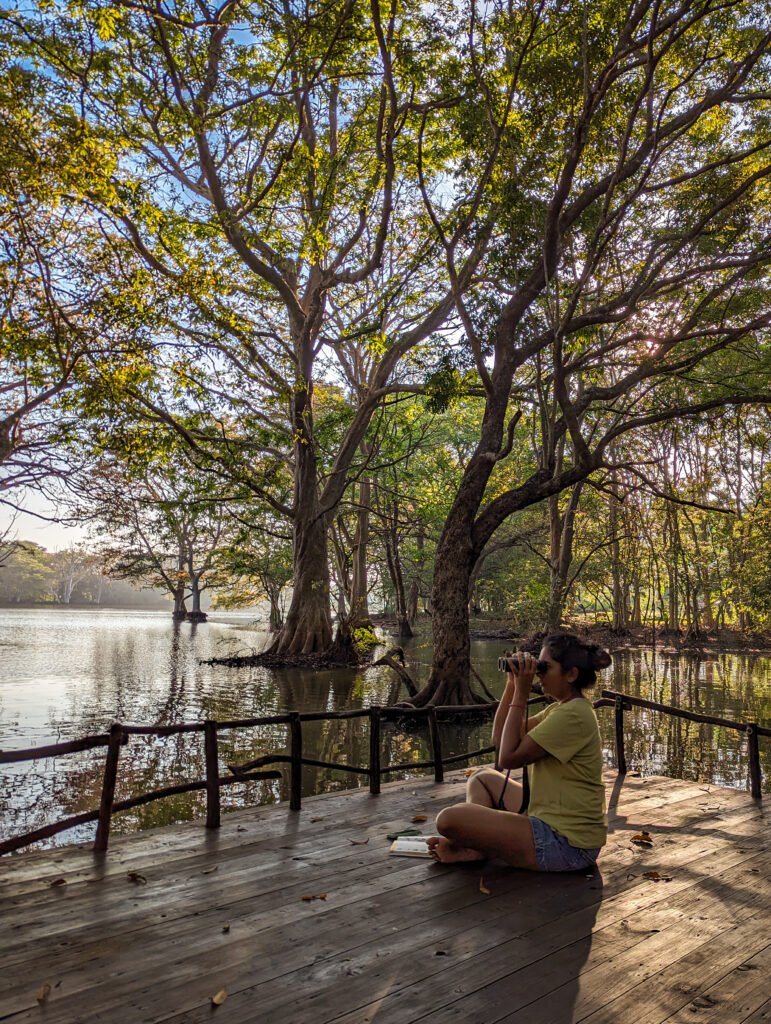
Morning walks along the Galkadawala Tank bund, watching schools of cormorants take a dip in the morning sun, are how I start my day. If the water level is high enough, I take a kayak out. I have my own route now: through the gasgommana, the tree-lined belt of vegetation along the tank, past the Grey-headed Fish Eagle’s lair, along the kumudu flower path with the Pygmy Geese, and back across the vast expanse of the tank.
The tank changes with the seasons. When the water drops too low, kayaking is no longer possible. So I sit patiently on the tank bund instead, watching the morning sun dance on the water. A recent find was an Oriental Dwarf Kingfisher hideout next to the bund. A hidden jewel.
Home-cooked vegetarian food awaits at mealtimes, cooked exactly how it would be in the surrounding villages. Most of the produce comes from nearby markets. Other than the rice paddy, growing much here is difficult because the macaques tend to get to it before anyone else does. Local fruits make fantastic drinks, and ash plantain crisps make even better snacks.
During meals, I am usually accompanied by a Sri Lanka Shama, foraging nearby while I eat. Great company, with its lovely song.
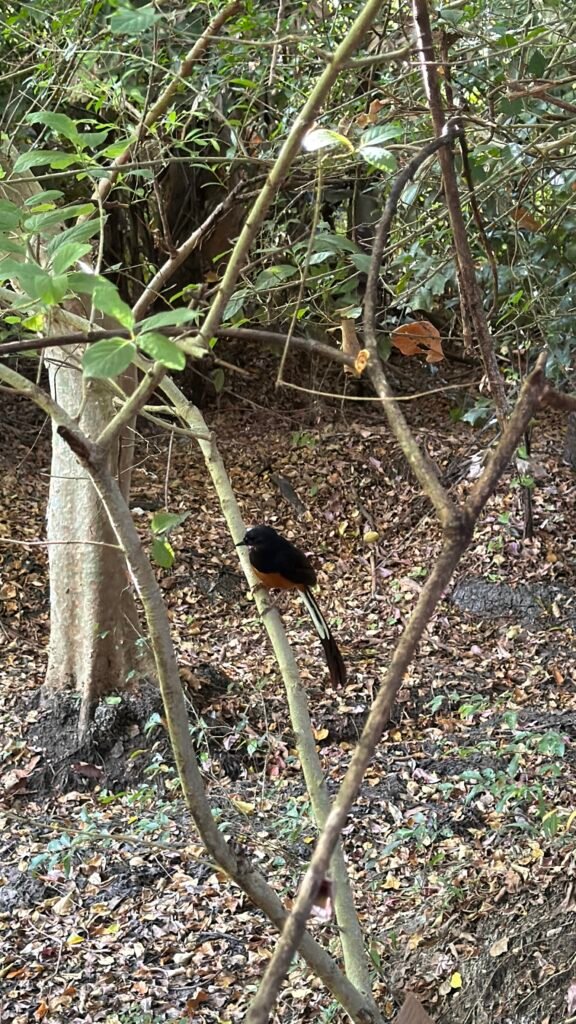
Most days at noon, I read under the canopy of four acres of reforested land, occasionally distracted by a bird fluttering past or an unfamiliar call. Or I take a nap while I listen to the rustle of leaves somewhere in the distance, the sound making its way towards me like a wave.
I watch the jungle change as clouds move overhead, the scorching heat filtering through layers of canopy before reaching the ground muted, leaving shifting patterns of light across the forest floor. That is pretty much it. Which, for me, is the point.
The evenings have become a routine of their own.
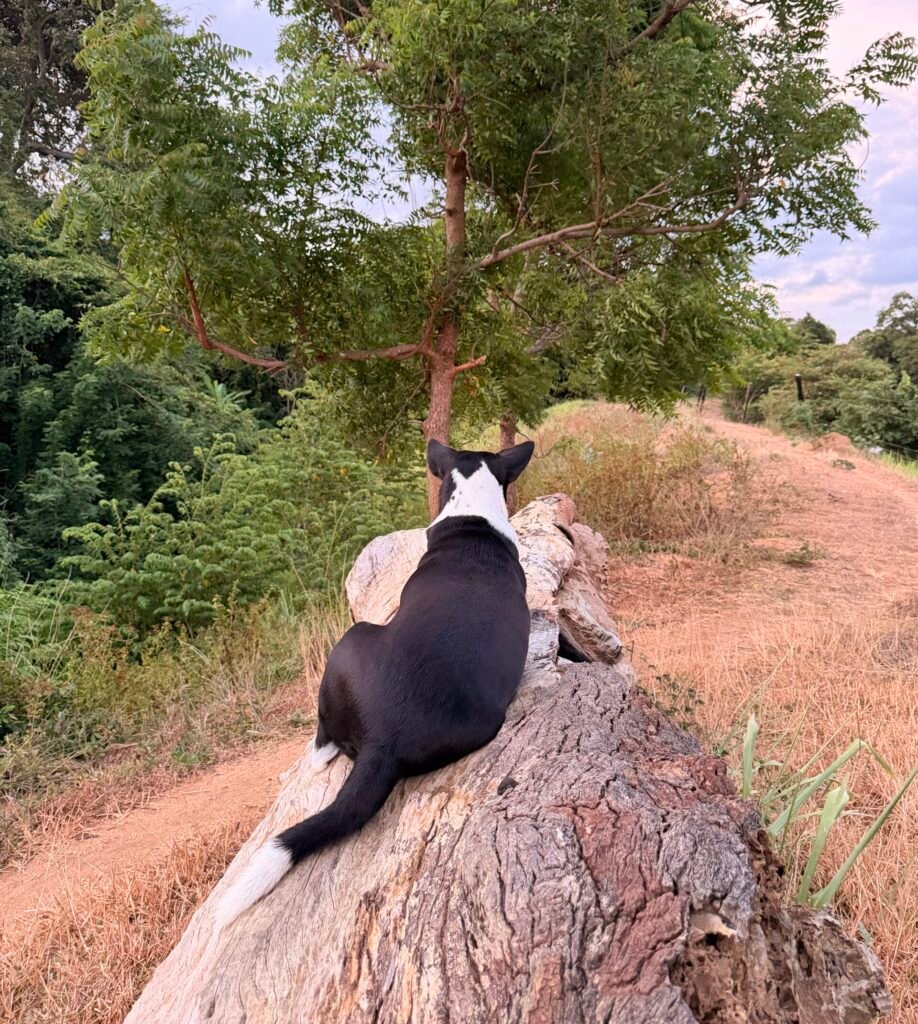
A walk to the nearby tank to watch the sun set while wild elephants gather on the opposite bank. I usually have an army of dogs to guard me, showing me the way, growling at any unfamiliar movement and then patiently waiting while I watch elephants and birds until the last light of the day disappears behind a moving cloud.
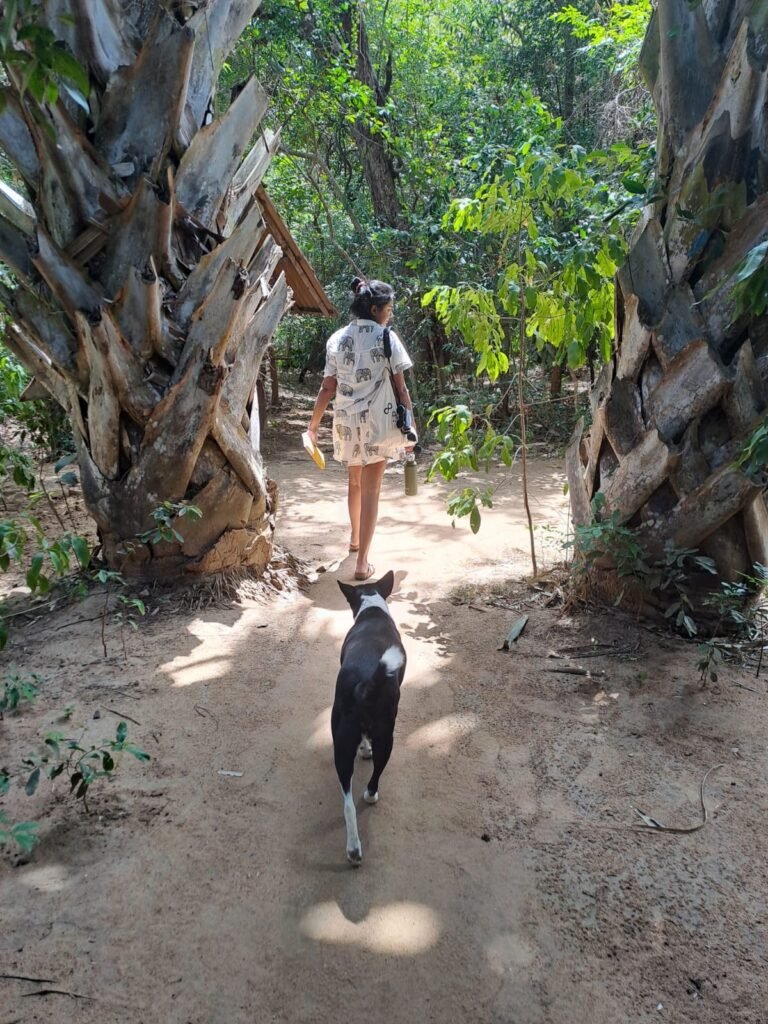
Once, while heading out near Palugaswewa to catch a sunset, I stumbled upon bear scat. I never saw the bear. Knowing one had been there was enough.
Ritigala, Again and Again
If I am here for more than three days, I make my way to Ritigala.
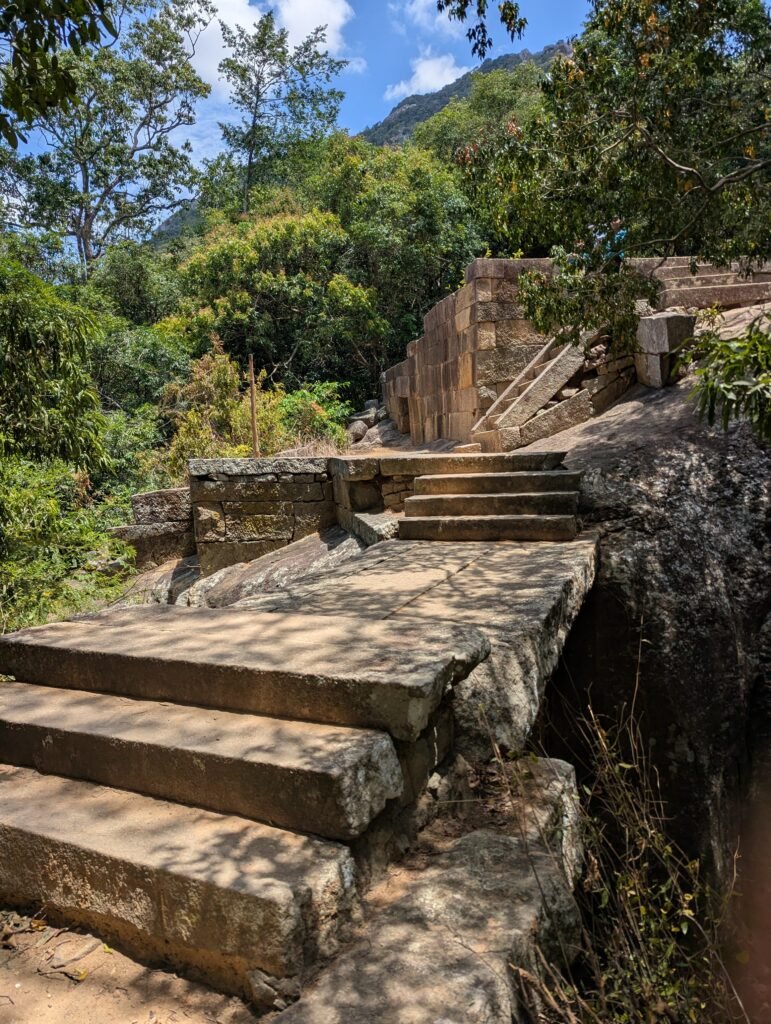
Ritigala is an ancient forest monastery surrounded by a Strict Nature Reserve, its stone pathways, caves and ruins disappearing into the forest. A day has never been enough for me. I keep going back, and every time I do there is something I somehow missed before. An ancient pond. A meditation area. An inscription. Another path disappearing into the forest. Sometimes, there is something the Archaeological Department has unearthed or restored since my last visit.
There is a peace to Ritigala, but I make sure to save it for weekdays. The hordes of pilgrims who arrive over weekends take some of that peace away. That is fine too. Ritigala is not there just for me.
Why I Keep Coming Back
This part of the dry zone is heaven to me precisely because not many people want to travel this way. Many would prefer a luxury resort and a buffet. I do too, sometimes. But most often, I am drawn to this. Basic amenities, but rich in experience.
Every visit has given me something different. A lifer, birder-speak for a bird you are seeing for the first time in your life. A new experience. Or a local who decides I need to see a particular sunset and takes me in their tuk-tuk or on the back of a motorbike to a tank I did not know existed, and couldn’t get to alone. This is elephant territory, and the locals are expert navigators of a landscape I would never attempt to cross by myself.
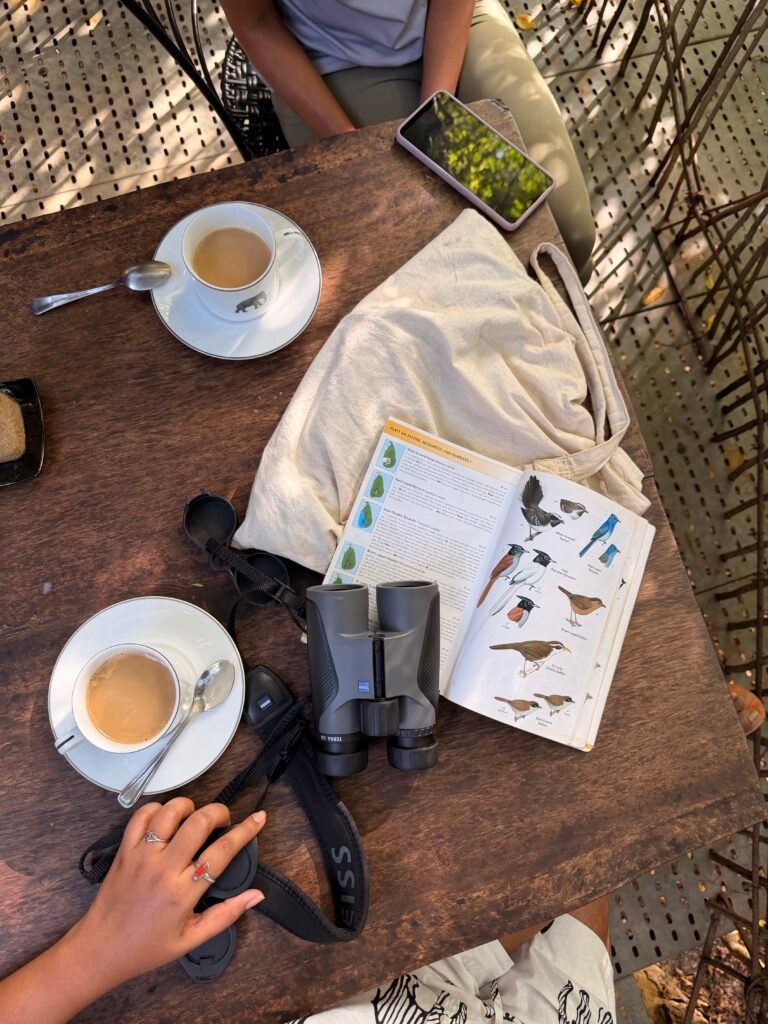
This is peak travel for me.
There is something underrated about returning to the same place. You stop trying to see everything and start noticing things you missed the last time. A different bird. A corner of Ritigala you somehow walked past before. Someone you have never met offering to show you somewhere you would never have found on your own. Or just another sunset from a place you thought you already knew.
A lot of The Curious Experience was built from travelling this way. Revisiting the same places and being content with whatever they have to give you that time. No expectations, no checklist. Sometimes a lifer, sometimes a stranger who takes you to a tank you have never heard of, and sometimes absolutely nothing happens.
Somehow, those are often the trips I remember most. Maybe that is why I keep going back.