
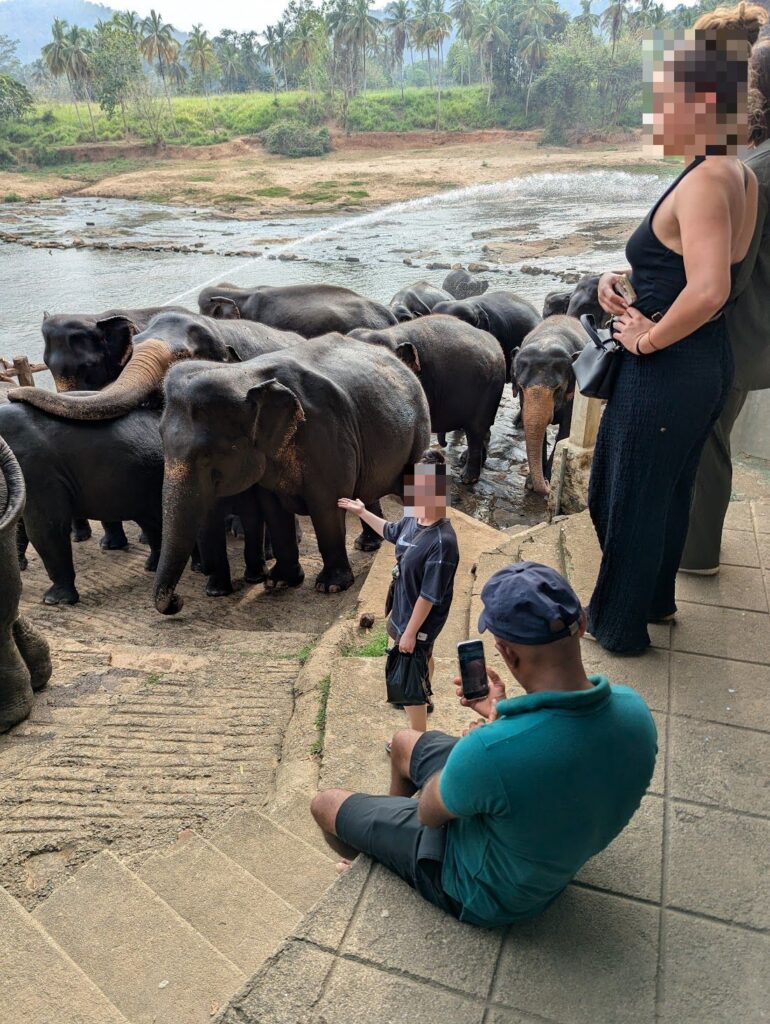
I can’t remember the last time I went to Pinnawala. It was probably when I was a schoolkid, just to see the elephants in action. Back then, I wasn’t particularly into wildlife, and I honestly can’t remember how I felt. But whether you are a wildlife enthusiast or not, anyone would feel a sense of awe seeing the largest land animal (technically the African elephant – but you get my point) up close, and that too in great numbers.
Fast forward to mid-February 2026. I finally decided to go on an inspection visit to the Pinnawala Elephant Orphanage, this time as a co-founder running a responsible travel company. I mentally prepared myself to face any malpractices happening there, but secretly hoped that the infamous claims were no longer true.
It was around 3pm when we turned off the main road just past Kegalle Town. Google Maps showed six kilometers to our destination. There was no traffic, and at first it was typical Sri Lankan scenery, trees, a couple of shops, houses, and home gardens. But very soon it transitioned into something else. Signboards appeared every hundred metres advertising someone’s “Elephant Village.”
I wasn’t entirely sure what these places were, but we continued driving until I saw a restaurant with two elephants chained at the entrance as welcome props.
I somehow managed not to let that scene disturb me and continued on to the orphanage.
A huge car park, surrounded by countless souvenir shops of all sizes welcomed us. For a Sunday during peak season, finding a parking spot was surprisingly easy. We parked, and a kind gentleman showed us the way to the entrance for locals. He also mentioned that 2-4pm was bathing time at the river. So we bought tickets and headed straight to the bathing area, located on the opposite side of the main premises.
The real madness begins now. Brace yourself.
A small road lined with more souvenir shops, homestays, restaurants, and hotels on both sides leads you towards the river. After about a 200 meter walk, you reach the banks of the Maha Oya.
From where I stood, the contrast was striking. One side of the river was concrete, built up, structured, and commercial. The other side remained wild and untouched. In between, the mighty giants stood in herds, bathing.
Suddenly all those advertisements and social media posts made sense. “Have lunch with elephants,” “Million-dollar view hotels.” “Infinity pools overlooking elephants.” When you go there yourself, you realise how congested everything is, built neck to neck with barely any breathing space.
We slowly made our way down to the observation area. A few mahouts stood with the elephants in the river, while others roamed around the viewing area. The first thing I noticed was how cautious some of the elephants appeared, particularly around one mahout who stood out from the rest. Every time he moved closer, they moved away.
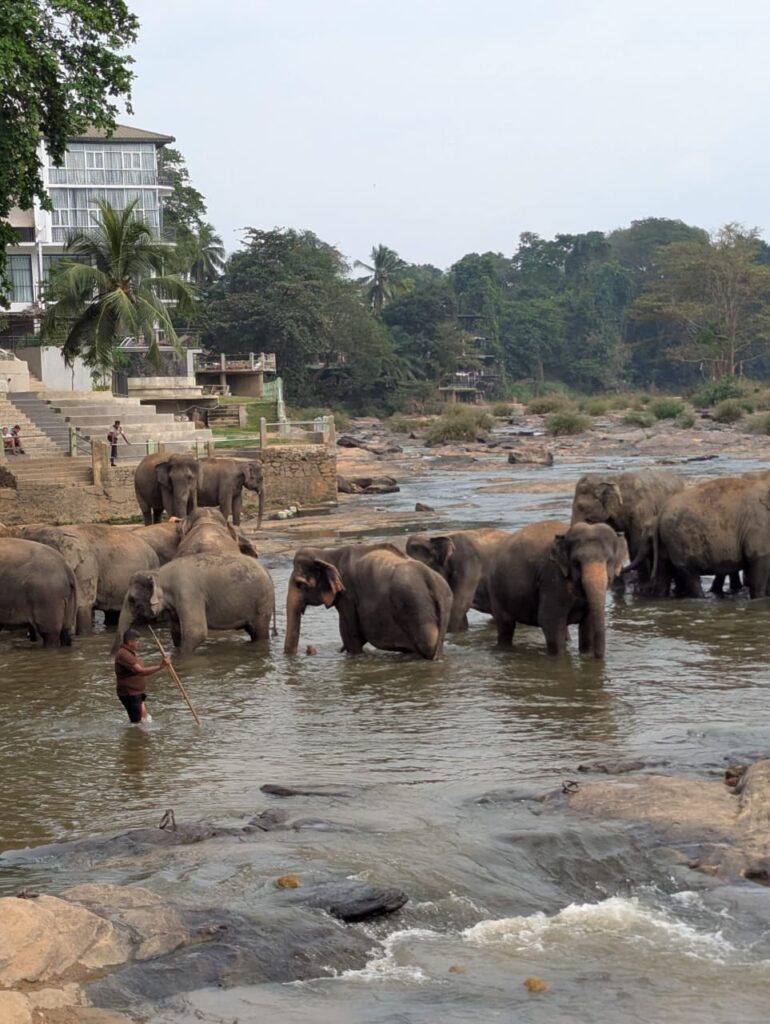
Then the “show” began.
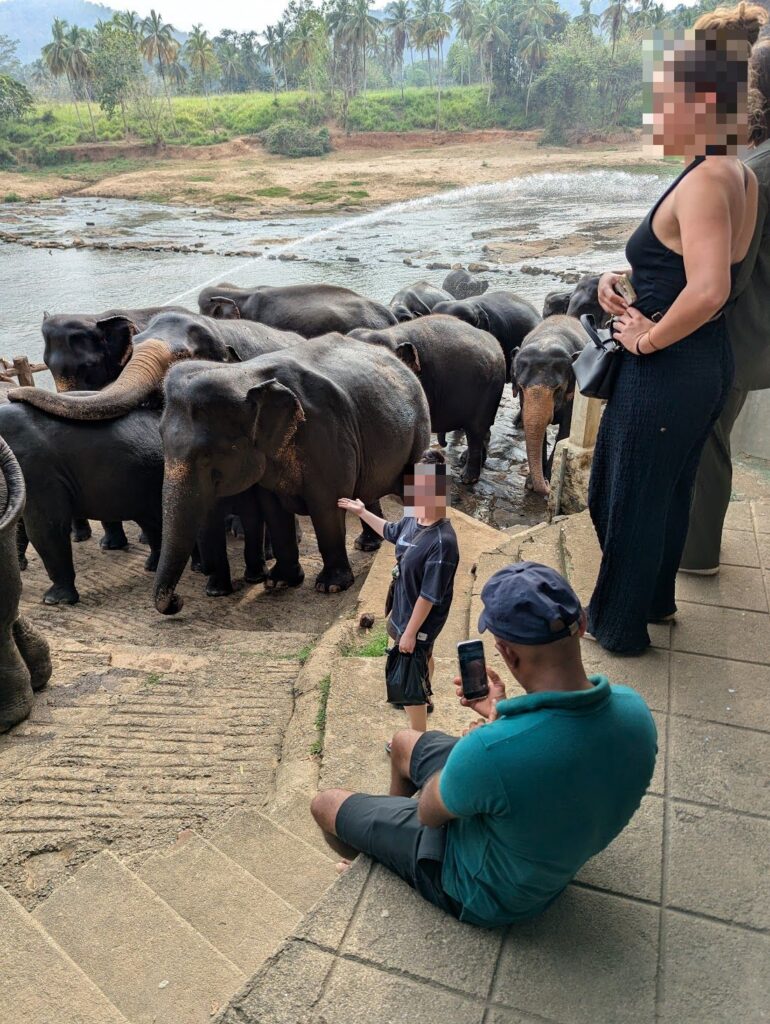
Some of the mahouts walking around approached tourists saying, “Do you want to take photos bathing the elephants? Only 1000 rupees, you can touch them too.” On the other end, elephants were being positioned closer to hotel walls so guests could feed them from balconies. It was astonishing to see how coordinated the whole operation seemed.
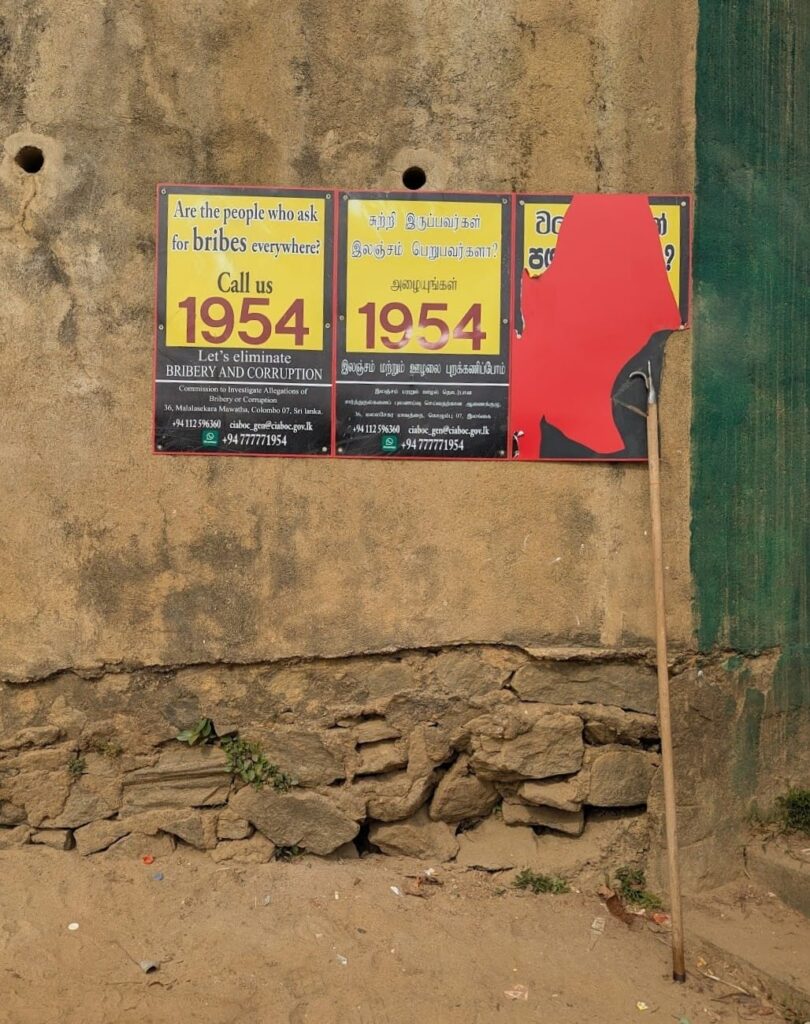
Amidst all this, I noticed another mahout tearing down a poster that raised awareness against bribery.
I was hoping someone would speak up against this absurdity. But it boiled down to two groups: tourists who thought it was a good bargain and happily participated, and others who simply observed and took photos from a distance.
It was painful to watch, especially when children, unaware of the ethics involved, watched in awe as their parents bathed elephants and posed for photos.
But then it struck me: I was no different as a child. I don’t remember feeding an elephant at Pinnawala, but I certainly wasn’t told it was wrong. Wildlife ethics weren’t instilled in me from a young age. They were learned later in life (thankfully!).
I’m sure most locals and tourists present that day were unaware of the consequences of these practices, or simply never questioned the bigger picture. So is there any point in pointing fingers at them?
I believe institutions like this need strict systems and clear regulations. They need to define their mandate and purpose. There must be proper oversight to weed out bad actors. Pinnawala is a large operation with multiple layers of staff involved. Awareness and education should take priority over tourism and souvenirs. Easier said than done.
By 4pm, the elephants were gathered and paraded back to the main premises, where they would be chained until the next morning, though they do have some free-roaming time between baths, as I heard.
A tourist seemed to have waited patiently for this moment. She had handed her phone to a mahout to capture an up-close photo. The lead mahout forcefully brought the largest elephant closer to her and said, “Don’t be scared, get closer, hold his trunk.”
After the photo session ended, the elephants were led back. We followed.
I was overwhelmed, a mix of emotions I thought I could handle, but clearly underestimated.
Back inside the orphanage, I was hoping to learn something. There were several informative posters about elephants and Pinnawala. One in particular caught my attention. The title was only in Sinhala and Tamil (local languages), but the text below was available in all three languages (English included).
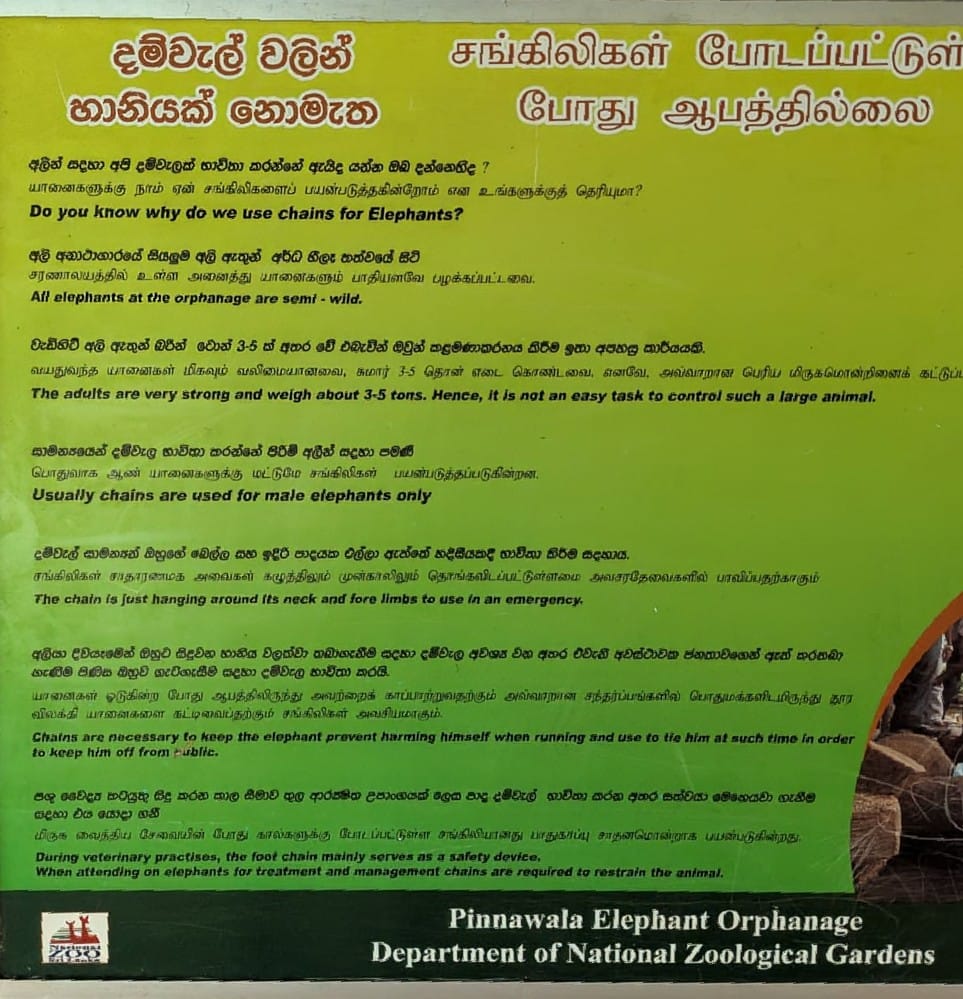
I wish even 10% of the effort that went into establishing souvenir shops had gone into visitor education on elephant conservation. Perhaps guided educational tours. More child-friendly educational posters.
Instead, inside the stables, each elephant stood chained in individual slots. You could see scars on their legs. You could see them struggle to reach their leafy meal just beyond their limit.
As we were leaving, since the orphanage closes at 6pm, I approached a staff member who appeared to be senior, wearing what looked like a police-style uniform. I greeted him and asked, “What is Pinnawala? What really happens here?”
He explained that Pinnawala began in 1975 as a shelter for injured and disabled elephants. Today, there are around 69 elephants, most of whom were born there.
I asked, “Why can’t they be sent back to the forest?”
He calmly replied, “It’s not easy. They are not used to the wild. They will not survive among wild elephants.”
He concluded by saying that Pinnawala is their only option.
If elephants are retained at Pinnawala with no intention of rewilding them, what is the long-term objective?
It is sad to see such a well-maintained institution with significant manpower operating without a clearly defined conservation goal. I am not sure how elephant welfare has improved because of the orphanage. But tourism has certainly penetrated the very fabric of life in Pinnawala.
From elephant villages promoting more bathing, feeding, and even rides, I checked reviews to understand their operations, to restaurants with chained elephants, an entire generation is growing up seeing elephants as economic assets.
For these children, what becomes “normal” is elephants in man-made routines, elephants in chains, and people benefiting financially from them.
For me, this is the most concerning impact of all.
I sincerely hope conservation is re-centred at Pinnawala, as it was intended in 1972, and that tourism complements the mission rather than hijacking it.
All of the above reflects my personal observations from a visit on 15th February 2026.
As a responsible travel company, we will continue to educate our travellers on why Pinnawala is not an ethical wildlife experience during their stay in Sri Lanka. For those genuinely interested in elephant conservation, we recommend visiting the Elephant Transit Home in Udawalawe, where rehabilitation and rewilding remain the primary objectives.
The Curious Experience exists to craft meaningful travel experiences in Sri Lanka rooted in curiosity, connection, and everyday life. We believe travel is a force for good, if done right.
So, are you aware of ethical wildlife viewing practices?
Written by Mathi Thayanan
Co-founder The Curious Experience
2 thoughts on “Pinnawala – When Tourism overtakes Conservation”
Such a sensitive description of a heart-wrenching experience, compassionate towards both humans and elephants. Change comes as knowledge better directs our resources and offers better ways of sustainable living (and tourism). I will not be visiting Pinnawala; thank you for guiding the way to a better future.
Thank you Kristina and we are glad it resonated with you.